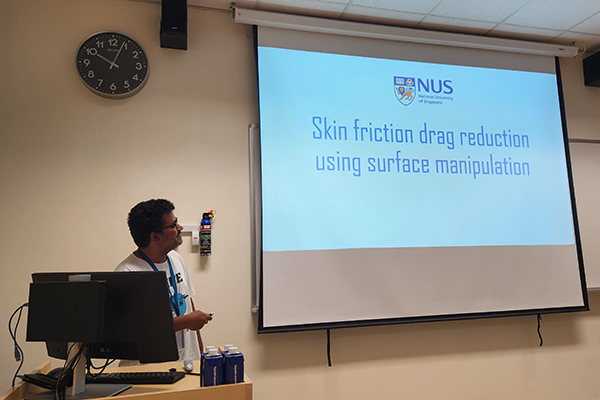
This study is based on a numerical investigation of drag reduction capability of spanwise secondary flow induced by macroscale corrugated surfaces in turbulent channel flow at a friction Reynolds number of 550 and amplitude to wavelength ratio (A/λ) of 0.125 to 0.0125 and half channel height to wavelength ratio (h/ λ) of 1 to 6.25. The study encompasses two types of macroscale corrugated surfaces: longitudinal and inclined. For the longitudinal corrugated surface, a pair of counter-rotating vortices in each wavelength lead to the occurrence of spanwise secondary flow, contributing to turbulence suppression in the valley region. Besides, spanwise secondary flow also influences in lifting of high turbulence fluid away from the wall. These results in the occurrence of thicker viscous layer which leads to the reduction in wall shear stress in longitudinal corrugated surface. The decrease in amplitude to wavelength ratio (A/λ), weakens the strength of spanwise secondary flow causing turbulence suppression also to be weaker and this leads to the viscous layer to be thinner. Consequently, this results in a decrease in the reduction of wall shear stress with the decrease in A/λ. The optimal drag reduction is observed at A/λ=0.025. Based on results obtained for longitudinal corrugated surface, the occurrence of spanwise secondary flow has a significant influence on reducing wall shear stress. Hence, to enhance the strength of spanwise secondary flow and its potential influence on reduction in wall shear stress, numerical simulations were conducted for inclined corrugated surfaces for inclination angles of 5.71, 11.31, and 16.70, while maintaining A/λ=0.025. From the results, the occurrence of a single vortex in each wavelength contributes to the generation of strong spanwise secondary flow in the valley region and weak secondary flow in the peak region. This contributes to the lifting of fluid with high turbulence away from the wall in the valley region and pulling towards the wall in the peak region which resulted in occurrence of a thicker and thinner viscous layer, respectively. The stronger spanwise secondary flow contributes to the incident of lifting up of fluid with high turbulence away from wall to be more prominent than pulling, resulting in average thickness of viscous layer to be thicker in inclined corrugated surface than that of smooth surface. This, in turn leads to an overall reduction in friction velocity or wall shear stress in inclined corrugated surface. Increase in inclination angle results in the viscous layer to be thicker under the influence of relatively stronger spanwise secondary flow and this contributed to an increase in the reduction of wall shear stress. Both longitudinal and inclined corrugated surfaces induce spanwise secondary flow, contributing significantly to wall shear stress reduction. However, the stronger spanwise secondary flow in inclined corrugated surfaces enhances the skin friction drag reduction further, suggesting the potential of macroscale corrugated surfaces for drag reduction in future studies.
|
 Born in 1987 in Lakhsmipur, Bangladesh, he completed his undergraduate degree in Aerospace Engineering from International Islamic University Malaysia, KL, Malaysia in 2015 and his PhD in Mechanical Engineering from National University of Singapore in 2020. Since 2020 he is a research scientist with the Centre of Aerodynamics and Propulsion at Temasek Laboratories, NUS where he engages in both experimental and computational aerodynamics. His interests are in turbulent boundary layer flows, vortex dynamics, flow control, fluid-structure interaction, flight dynamics and control. Born in 1987 in Lakhsmipur, Bangladesh, he completed his undergraduate degree in Aerospace Engineering from International Islamic University Malaysia, KL, Malaysia in 2015 and his PhD in Mechanical Engineering from National University of Singapore in 2020. Since 2020 he is a research scientist with the Centre of Aerodynamics and Propulsion at Temasek Laboratories, NUS where he engages in both experimental and computational aerodynamics. His interests are in turbulent boundary layer flows, vortex dynamics, flow control, fluid-structure interaction, flight dynamics and control.
|

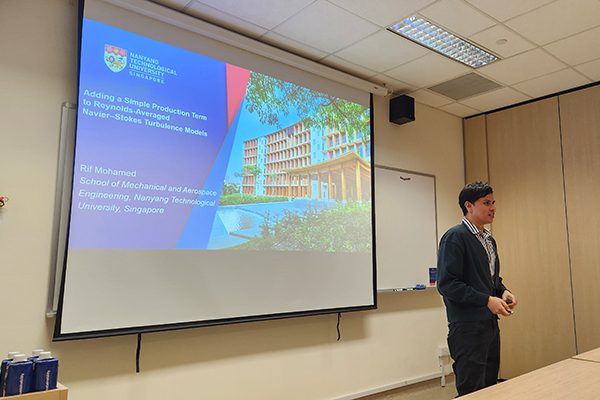


 Rif Mohamed was appointed as a Lecturer in the School of Mechanical and Aerospace Engineering at Nanyang Technological University in 2023. His research interests span turbulence modeling, wind resource assessment, and helicopter aerodynamics. Rif has established a diverse research portfolio that also includes data-driven methods in air traffic conflict detection and fluid dynamics. Notable collaborations include projects with Leonardo Helicopter and research funded by the Civil Aviation Authority of Singapore (CAAS) during his tenure at the Air Traffic Management Research Institute. In his research, Rif applies Computational Fluid Dynamics (CFD) and machine learning techniques, as well as develops applications through Python.