
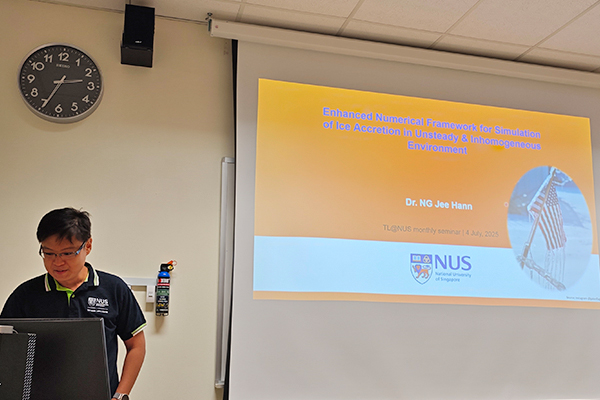
Enhanced Numerical Framework for Simulation of Ice Accretion in Unsteady & Inhomogeneous Environment |
| 4 July 2025, Friday, 2:30pm to 3:00pm | Speaker: Dr. Ng Jee Hann, Senior Research Scientist, Temasek Laboratories, NUS |
| Venue: Seminar Room 8D-1, Level 8, Temasek Laboratories | Event Organiser Host: Dr. Huang Xin |
ABSTRACT |
An aircraft flying in an icing environment is susceptible to ice accretion that would continuously degrade its aerodynamic performance, leading to eventual or sometimes sudden loss in lift and control. Thus, accurate and robust numerical tools to simulate such complex three-phase flow phenomena are highly sought after by aircraft designers. Past numerical studies often predict ice accretion under a steady freestream condition, and assume exposure to a constant, homogeneous icing environment. In practice, high risk of ice accretion is usually observed over a narrow range of altitude with an abundant presence of supercooled water droplets, which are the culprit of ice formation. Meteorologically, such region is called the “icing layer”. Consequently, an aircraft would be more susceptible to ice accretion during the climbing or the landing phase as it traverses the “icing layer”, rather than during flight at the higher cruise altitude. Ice accretion is usually simulated with a loosely-coupled, iterative approach, commonly known as the multishot framework. Due to the continuous build-up of ice during the iterative simulation, a remeshing step is crucial to maintain the mesh quality. An enhanced framework has thus been developed to provide a robust and fast remeshing routine for ice accretion on an airfoil. The ability to prescribe time-dependent freestream and icing conditions is also incorporated into the enhanced framework, enabling the simulation of ice accretion during climbing and landing with altitude-varying conditions. In this presentation, ice accretion on an RG-15 airfoil exposed to both rime and glaze ice conditions, with and without an altitude-varying liquid water content (LWC), will be discussed. LWC is a measure of the concentration of supercooled water droplets in the atmosphere, and it is a key parameter dictating the icing severity. Depending on the vertical profile of LWC, predicting ice accretion under a constant LWC may under- or over-predict the ice growth, as well as the associated aerodynamic performance degradation. |
| ABOUT THE SPEAKER |
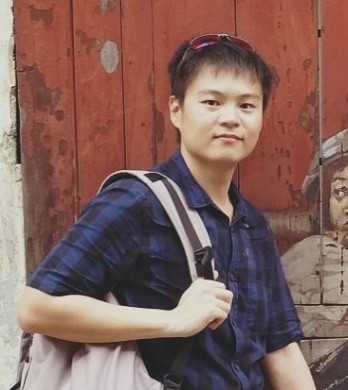 Dr. Ng Jee Hann graduated from the National University of Singapore with a Bachelor of Engineering (Mechanical) and a Ph.D. in 2012 and 2016, respectively. He then worked as a Research Fellow in the Department of Mechanical Engineering at the National University of Singapore until 2018. He has been working at the Temasek Laboratories@NUS since 2019. His research works are primarily numerical based, spanning areas such as turbulent drag reduction, aerodynamic flow control, in-flight icing, pressure gain combustion, aeroelasticity, Taylor-Couette flows, rarefied flows, and bluff body flows. Dr. Ng Jee Hann graduated from the National University of Singapore with a Bachelor of Engineering (Mechanical) and a Ph.D. in 2012 and 2016, respectively. He then worked as a Research Fellow in the Department of Mechanical Engineering at the National University of Singapore until 2018. He has been working at the Temasek Laboratories@NUS since 2019. His research works are primarily numerical based, spanning areas such as turbulent drag reduction, aerodynamic flow control, in-flight icing, pressure gain combustion, aeroelasticity, Taylor-Couette flows, rarefied flows, and bluff body flows.
|


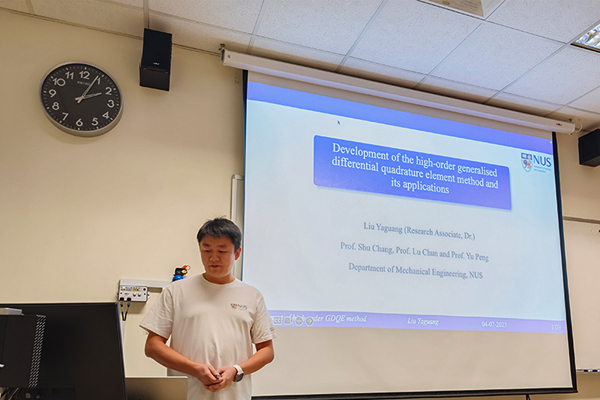
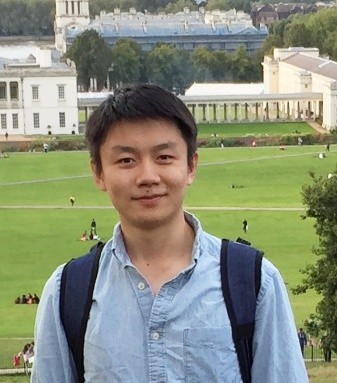 Dr. Liu Yaguang is currently a Research Associate in the Department of Mechanical Engineering at the National University of Singapore (NUS). He obtained his Ph.D. in Mechanical Engineering (Fluid Mechanics) from NUS in 2024 and an M.Sc. (with Distinction) in Advanced Computational Methods from Imperial College London in 2015. Previously, he worked as an Aerodynamic Engineer at Sinoma Wind Power Blade Co., Ltd. (2015–2019) and as a Research Assistant at the Southern University of Science and Technology (2019–2020). Dr. Liu’s research focuses on the development of advanced numerical methods for simulating both continuum and rarefied gas flows.