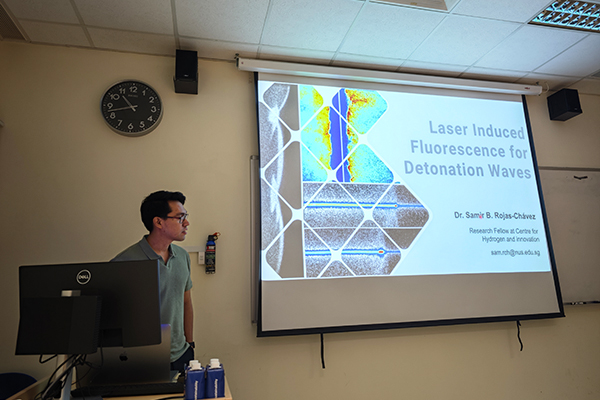
Laser Induced Fluorescence for Detonations Waves |
| 30 October 2024, Wednesday, 10:30am to 11:00am | Speaker: Dr. Samir Rojas-Chávez, Research Fellow, Centre for Hydrogen Innovation, NUS |
| Venue: Seminar Room 8D-1, Level 8, Temasek Laboratories | Event Organiser Host: Dr. Huang Xin |
ABSTRACT |
Detonations, supersonic combustion waves, are important for energy production and propulsion systems, exemplified by detonation devices, promising greater thermal efficiency compared to the current technologies. Despite their potential benefits, the complexity of detonations poses challenges for accurate characterization, crucial for safety and performance optimization of detonation devices. Conventional visualization techniques struggle to capture their unique properties effectively. While laser diagnostics excel in subsonic combustion, they often fall short in detonation environments. This presentation addresses this gap by comprehensively evaluating the laser-induced fluorescence (LIF) technique, focusing on three-dimensional hydrogen-fuelled detonations. Through experimental and numerical analyses, the study systematically explores LIF excitation strategies to enhance the qualitative and quantitative understanding of detonation fronts. The first study optimizes OH-LIF imaging in hydrogen-fueled detonations, identifying excitation schemes that significantly improve the qualitative detection of OH radicals, providing a more accurate representation of the OH field. The second part introduces a proof-of-concept for measuring an important chemical characteristic length scale using NO-LIF in stoichiometric H2-air mixtures. The third study demonstrates the simultaneous application of OH-LIF and NO-LIF diagnostics, effectively depicting both the OH-reaction zone structure and the induction zone. Comparative assessments highlight that combining both techniques enhanced capabilities for analyzing detonations, particularly in engine conditions. |
| ABOUT THE SPEAKER |
| Samir Rojas-Chávez is a Research Fellow at the Centre for Hydrogen Innovation, National University of Singapore (NUS), specializing in ammonia combustion. He holds a bachelor’s degree in Energy Engineering from the National University of Santa (Peru) and a Master's degree in Mechanical Engineering from São Paulo State University (Brazil). He completed his PhD in Mechanical Engineering at King Abdullah University of Science and Technology (Saudi Arabia). His research is dedicated to advancing optical diagnostic methods to investigate flame and detonation waves, contributing to advancements in clean energy technologies. |
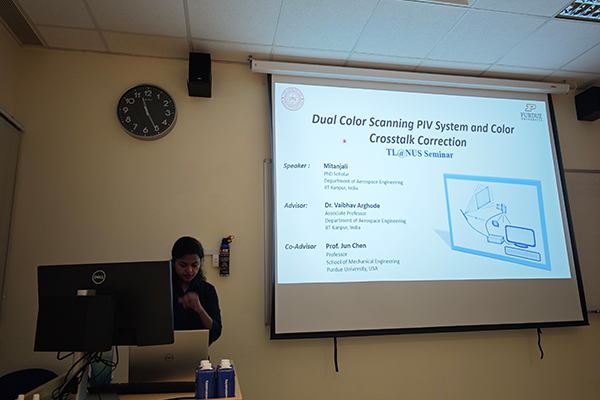
Dual Color Scanning PIV System & Color Crosstalk Correction |
|
|
| 30 October 2024, Wednesday, 11:00am to 11:30am | Speaker: Ms. Mitanjali, PhD Scholar, Aerospace Engineering, IIT Kanpur |
| Venue: Seminar Room 8D-1, Level 8, Temasek Laboratories | Event Organiser Host: Dr. Huang Xin |
ABSTRACT |
The talk will explore the dual-color scanning Particle Image Velocimetry (PIV) system, which highlights the method of scanning illumination using continuous laser beams. The system employs two continuous-wave diode-pumped solid-state (CW DPSS) lasers of different wavelengths to illuminate a region of interest. This dual-wavelength approach helps to alleviate directional ambiguity, as the illuminations from both lasers are captured in a single frame by a conventional DSLR camera. While this system offers a cost-effective solution with simplified synchronization compared to traditional PIV systems, it can also introduce issues of color crosstalk in images. The phenomenon of color crosstalk occurs when the light of one color leaks into neighbouring pixels that have different color filters on the imaging sensor. This results in the appearance of unwanted particle images, known as “ghost particles”, which can significantly compromise the accuracy of velocity measurements. To address this issue, a color crosstalk correction algorithm is proposed that corrects the captured images to mitigate these artifacts. Following correction, the images are further analyzed to derive the velocity field. The effectiveness of the scanning PIV system is demonstrated through measurements of the flow field downstream of a moving circular cylinder, capturing the dynamics of vortex shedding. Additionally, we will discuss the broader applicability of the proposed scanning PIV system in various experimental contexts. |
| ABOUT THE SPEAKER |
Mitanjali is currently a PhD student in the Department of Aerospace Engineering at the Indian Institute of Technology (IIT) Kanpur, specializing in experimental fluid dynamics and optical diagnostic techniques. Her research focuses on developing scanning particle image velocimetry methods for measuring 2D velocities. She spent two years as a visiting research scholar in the Department of Mechanical Engineering at Purdue University, USA. During her time at Purdue, she worked on building the experimental setup for the scanning PIV system and conducted numerical simulations of indoor chambers to study HVAC system performance and indoor air quality. She is passionate about advancing fluid dynamics through both experimental and numerical techniques. |