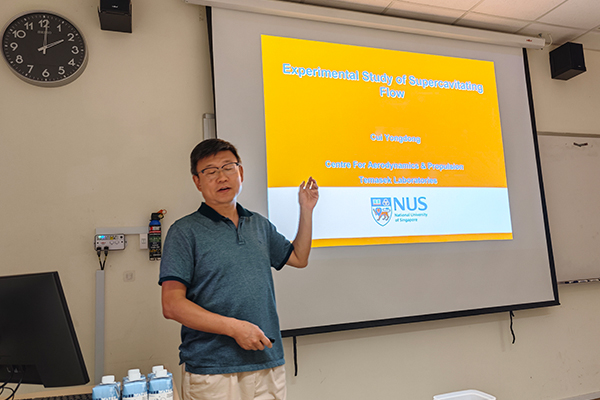
Experimental Study of Cavitating Flow |
| 1 August 2025, Friday, 2:00pm to 2:30pm |
Speaker: Dr. Cui Yongdong, Principal Research Scientist, Temasek Laboratories, NUS
|
| Venue: Seminar Room 8D-1, Level 8, Temasek Laboratories |
Event Organiser Host: Dr. Huang Xin |
|
ABSTRACT |
With the increase in cruising speed, underwater vehicles may encounter a significant phenomenon known as cavitating flow, which can greatly affect their performance. In this talk, I will provide an overview of various experimental facilities used to study cavitating flow, based on a detailed literature survey, and discuss their respective advantages and limitations. I will also address main challenges in constructing such facilities and in characterizing cavitating flows.
Additionally, I will present our in-house development of an air-assisted launching system in a water tank, share some experimental results, outline its current limitations, and propose ideas for enhancing its capability to generate more valuable data for numerical validation and to advance our understanding of cavitating flow phenomena.
|
|
| ABOUT THE SPEAKER |
| |
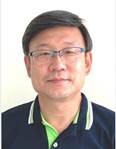 Dr. Cui Yongdong is a Principal Research Scientist and Group Head at the Centre for Aerodynamics & Propulsion, Temasek Laboratories, National University of Singapore (NUS). His research interests lie broadly in experimental aerodynamics and hydrodynamics, with a focus on high-lift devices, drag reduction, flow control, plasma aerodynamics, and supercavitation. He is also an Associate Fellow of the American Institute of Aeronautics and Astronautics (AIAA). Dr. Cui Yongdong is a Principal Research Scientist and Group Head at the Centre for Aerodynamics & Propulsion, Temasek Laboratories, National University of Singapore (NUS). His research interests lie broadly in experimental aerodynamics and hydrodynamics, with a focus on high-lift devices, drag reduction, flow control, plasma aerodynamics, and supercavitation. He is also an Associate Fellow of the American Institute of Aeronautics and Astronautics (AIAA).
|
|
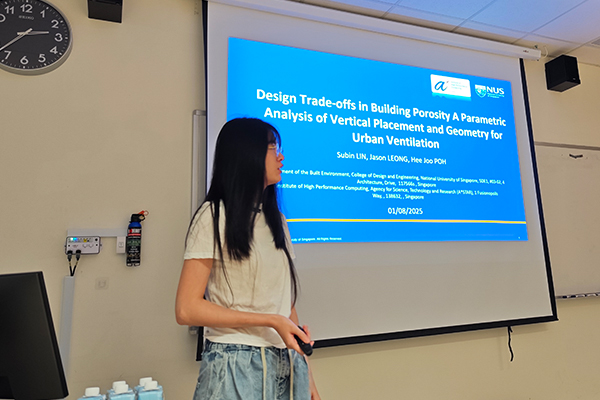
Design Trade-offs in Building Porosity: A Parametric Analysis of Vertical Placement and Geometry for Urban Ventilation |
| 1 August 2025, Friday, 2:30pm to 3:00pm |
Speaker: Ms. Lin Subin, PhD candidate, Department of the Built Environment, College of Design and Engineering, NUS
|
| Venue: Seminar Room 8D-1, Level 8, Temasek Laboratories |
Event Organiser Host: Dr. Huang Xin |
|
ABSTRACT |
This study investigates the critical influence of building porosity's vertical placement and geometric configuration on street canyon airflow. While porosity is increasingly advocated for urban ventilation, a systematic understanding of how these design parameters affect performance is lacking. The purpose of this research is to decouple these effects through a parametric computational fluid dynamics (CFD) study. A Reynolds-Averaged Navier-Stokes (RANS) model, validated against experimental data, was used to analyze a series of idealized building configurations.
Two sets of simulations were conducted. The first compared identical porous openings placed at six different vertical levels, from the ground floor upwards. The second investigated various opening geometries at a fixed mid-building level. Principal results reveal a stark difference in performance based on vertical position. Ground-level porosity was found to be most effective for preserving robust pedestrian-level wind flow. In contrast, mid- and upper-level porosity consistently degraded near-ground conditions relative to the ground-level case, with some configurations causing significant velocity deficits. Furthermore, for a fixed vertical level, the specific geometry of the opening was also shown to be a highly sensitive parameter.
The major conclusion is that the vertical location of porosity is the primary determinant of pedestrian-level ventilation. A "one-size-fits-all" approach to porosity design is ineffective; the optimal solution is highly dependent on the targeted ventilation objective (e.g., pedestrian comfort vs. upper-level air exchange).
|
|
| ABOUT THE SPEAKER |
| |
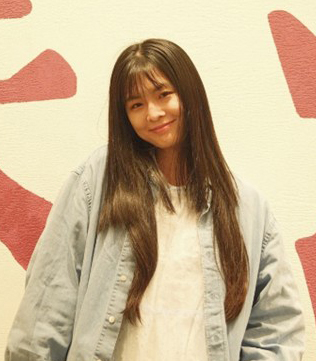 Ms. Lin Subin is currently a PhD candidate in the Department of the Built Environment, College of Design and Engineering, National University of Singapore, supervised by Prof. Hee Joo Poh. She is also SINGA scholar under Institute of High Performance Computing, Agency for Science, Technology and Research (A*STAR). She is currently pursuing the research of computational fluid dynamics (CFD) of outdoor ventilation, focusing on the building porosity in street canyon. Previously she worked on big data in water treatment plant with time series prediction using graph attention neural network. This also include targeted data analysis and processing with field knowledge. She completed her master degree at Korea Advanced Institute of Science and Technology (KAIST), bachelor degree at Israel Institute of Technology (Technion). Ms. Lin Subin is currently a PhD candidate in the Department of the Built Environment, College of Design and Engineering, National University of Singapore, supervised by Prof. Hee Joo Poh. She is also SINGA scholar under Institute of High Performance Computing, Agency for Science, Technology and Research (A*STAR). She is currently pursuing the research of computational fluid dynamics (CFD) of outdoor ventilation, focusing on the building porosity in street canyon. Previously she worked on big data in water treatment plant with time series prediction using graph attention neural network. This also include targeted data analysis and processing with field knowledge. She completed her master degree at Korea Advanced Institute of Science and Technology (KAIST), bachelor degree at Israel Institute of Technology (Technion).
|
|